


Module · Checklists & Inspection Plans
Digital Checklists and Inspection Plans
Paper lists go missing, folders pile up, and when it matters the proof is gone. With the QMSpot checklist module you define what gets inspected, who inspects it and how often — per site or globally for all of them. Completed inspections go straight into the report.
- Ten inspection item types freely combined
- Mark critical points as CCP
- Export reports as Excel or PDF
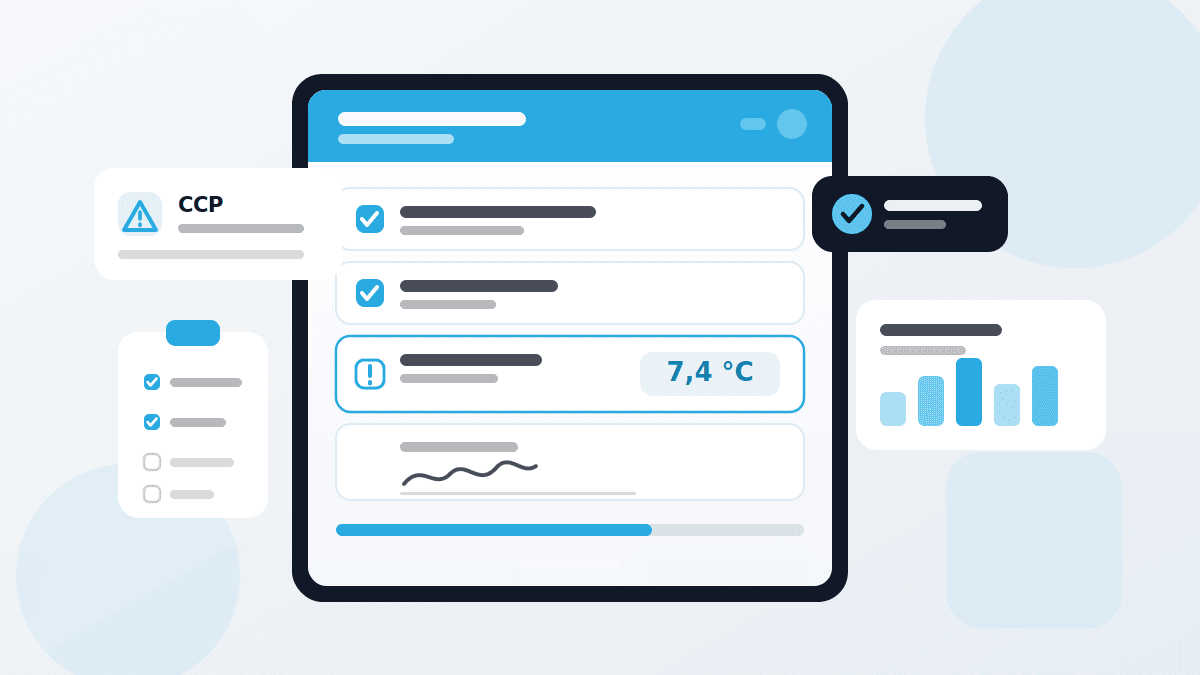
What the checklist module does
An inspection item is the smallest unit of a checklist. QMSpot offers ten types — you combine them the way your inspection actually runs.
For every inspection item you decide whether it is mandatory. Safety-critical points are marked as Critical Control Points. For numeric values you define target and limit values that make deviations visible. Dependencies show a follow-up question only when a particular answer was given — if the inspector selects "Yes", the detail question appears, otherwise the list stays short.
When something deviates, nobody has to remember to raise a defect: a selection list with validation, or a numeric value outside its target range, creates one automatically, complete with a pre-filled note. The stored procedure note appears right away and tells the inspector what to do next. If the defect can be fixed on the spot, it is closed there and then.
Checkbox
simple yes/no format for visual checks
Selection list
predefined options; with validation a wrong answer raises a defect
Free text
single-line or multi-line, for open answers
Numeric value
numeric values with a target range — a deviation raises a defect
Signature
electronic confirmation by signature
Measuring point
direct integration with sensors
Location
outputs the geo-location
Timestamp
documents when the inspection took place
How an inspection runs
From template to proof — four steps that repeat the same way in every operation.
1. Create a checklist
Name, description, recurrence — and whether the list applies to one site or all of them. Copy similar lists instead.
2. Work with templates
Save recurring checklists as templates and sort them into categories such as Hygiene, Safety or Maintenance.
3. Record the deviation
When an item is not met, a defect is created with a note and a procedure note — a photo can be made mandatory.
4. Prove it
Completed inspections land in the report, filterable by site, date and user. Export as Excel or PDF.
How it works with the other modules
Cross-module, flexible and practical
The checklist module does not stand alone. It is the point where the other modules connect.
- Sensors & Temperature — inspection items of the measuring point type pull their values straight from the sensor
- Defect Management — deviations are followed up as defects, with an owner and a deadline
- Audits — the same inspection logic, on a larger scale
- Training — whoever inspects has to be instructed
- Device Management — maintenance, inspection and calibration of the devices behind the readings
Your data is handled in compliance with the GDPR.